
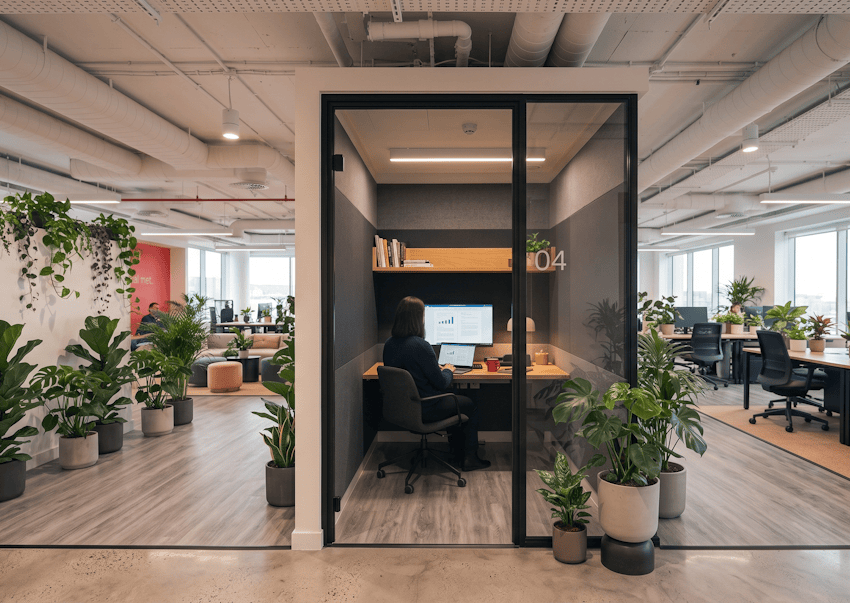
Small focus rooms are enclosed rooms for one or two people. You book them the same way you book a meeting room. That is the main thing that sets them apart from a solo pod. A pod is something you grab for a few minutes. A focus room is something you reserve for an hour or two, so it fits a longer stretch of concentration, a mentoring session, or a private client call. You get a door that shuts, a proper desk, and a booking that holds the room for you. Most offices keep only a handful of these. They sit between the pod, which is informal and quick, and the full meeting room, which is set up for a group. Below, we discuss how to size these rooms, design them, run them, and track whether they earn their floor space in ecobook.
When and Why Organisations Use Small Focus Rooms
People reach for a small focus room when the open plan gets in the way. You cannot take a salary conversation at your desk. You cannot run a candidate call with three colleagues listening in. A focus room gives you a door and an hour. How many you need depends a lot on how your teams work. A firm that runs a lot of one to one coaching will lean on them. A team that is mostly remote and comes in once a week will barely touch them.
You tend to want small focus rooms when:
1. You run regular one to one sessions. Reviews, coaching, and check ins all need a door.
2. You take confidential calls. HR, legal, and client work should not happen in the open.
3. Your open plan is busy. The more people around, the more a quiet room gets used.
4. You want longer focus without booking a whole meeting room. An hour of deep work does not need a six seat table.
Small Focus Rooms Specifications
| Specification | Guidance |
| Floor area | Enough room for one person, or two at a push, without feeling boxed in. |
| Capacity | One person for solo work, two for a one to one. |
| Booking | Bookable through ecobook, usually in short blocks of an hour or two. |
| Enclosure | Fully enclosed, with sound treatment, or glass with privacy film. |
| Door swing | Opens outward into the walkway so the occupant controls the space. |
| Desk/work surface | A real desk or counter, big enough for a laptop and notes, with a comfortable chair. |
| Acoustic performance | Holds normal speech in. Soft finishes cut echo and outside noise. |
| Power and connectivity | A couple of power outlets and a data point so people can plug in and work. |
Design Considerations
Two things make or break a focus room: sound and comfort. If people can hear you through the wall, the room is pointless, so the walls, door, and glass have to hold normal speech in. Soft finishes help kill the echo inside a small box. The room should feel calm, not sealed. Glass with privacy film keeps it from feeling like a cupboard while still hiding the screen.
The rest is about fit and findability. A cramped desk and a hard chair send people back to their own seat. Give them a real work surface and a chair they can sit in for an hour. Put the room somewhere people walk past, and light it well. A good focus room in a dead corner still sits empty.
Common Mistakes to Avoid
A few mistakes come up again and again:
1. Building too many too soon. Start small and add rooms once the data shows real demand.
2. Skimping on sound. Thin walls turn a private room into a fishbowl.
3. Cramped or cheap furniture. A tight, uncomfortable room gets skipped.
4. Hiding the room. If people cannot find it or reach it, it stays empty.
5. No booking rules. Without limits, one person parks in it all day.
How Small Focus Rooms Are Managed in ecobook
You run small focus rooms one of two ways. You can make them bookable as a desk booking system, so people reserve a slot in ecobook and the room is held for them. The downside is that rooms get booked and then not used, and no shows lock others out. Or you can leave them first come first served, which is simpler and needs no admin. The downside is that someone can sit in one all afternoon and you have no record of who or when.
Either way, ecobook shows you what is happening. Booking data tells you the busy times and which rooms fill first. Occupancy sensors, if you have them, tell you how long people actually stay and whether booked rooms sit empty. Use that to decide whether to add rooms, move them, or tighten the time limits.
Frequently Asked Questions
How much of this space type do we need?
Start with a small number and watch the booking and sensor data. If the rooms are full most of the day, add more. If they sit empty, check whether people can find them, or even know they exist, before you pull them out.
Should this space be bookable or first-come-first-served?
It depends on your use case. If demand is high and people plan ahead, booking works and holds the room. If use is sporadic, first come first served is simpler. Track the pattern in ecobook and switch the policy if it stops working.
How do we ensure equitable access to private spaces?
Set clear rules. Time limits, a booking cap, and a bit of visibility go a long way. ecobook can enforce limits and flag when someone overuses a room. Tell people what the rooms are for and roughly when they are free.
Wrapping Up
For example, a consulting firm of around 250 people kept booking its eight seat boardroom for one to one reviews. Managers wanted privacy, and the open plan did not give it. They turned two quiet corners into small focus rooms and made them bookable in ecobook. The boardroom freed up, the reviews got easier, and the booking data showed both rooms full by mid morning most days. Plan your focus rooms around real usage, connect them to ecobook, and let the data tell you when to add more. Book a walkthrough with ecobook today.