In today’s hybrid world, the workplace experience manager has become one of the most important – and misunderstood – roles in any organization. Once focused mainly on “office management,” this position now sits at the intersection of people, place, and technology, shaping how employees feel and perform whether they’re at home, in the office, or somewhere in between.
This article explores how the role has evolved, the challenges it faces, the trends shaping its future, and the key responsibilities that define a strong workplace experience manager.
From office manager to hybrid experience owner
Traditionally, the role centered on front‑of‑house operations: reception, facilities coordination, meeting rooms, supplies, and basic amenities. In a largely office‑first world, success meant a smooth, comfortable environment and reliable day‑to‑day operations.
Hybrid work changed that.
Employees now move fluidly between home and office. A recent Gallup Poll shows 52% of employees are in a hybrid environment while 26% are exclusively on remote. The “workplace” is no longer a single building, but a network of physical and digital touchpoints – office hubs, collaboration tools, booking apps, events, and policies.
A modern workplace experience manager needs to:
- Design experiences that work for both in‑office and remote staff
- Think holistically about the “workday journey” from planning an office day to leaving the building
- Partner closely with HR, IT, and Facilities to align space, culture, and technology
Instead of just keeping the lights on, they are responsible for ensuring the workplace actively supports productivity, collaboration, and connection. Today, a workplace experience manager has executive level Key Performance Indicators (KPIs) assigned to them.
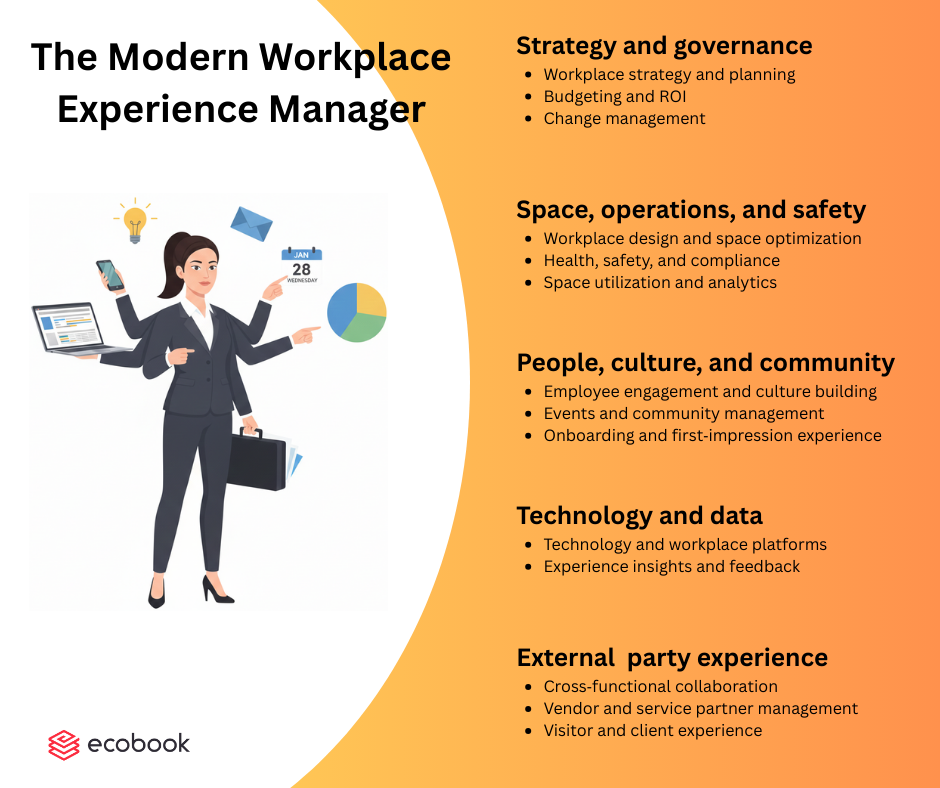
Core responsibilities of a workplace experience manager
|
|
|
|---|---|
|
Strategy & Governance
|
|
|
Workplace strategy and planning
|
Translate business and people strategy into a clear plan for how workplace, services, and policies support effective work.
|
|
Budgeting and ROI
|
Build and manage budgets for workplace programs and demonstrate the value of experience investments with clear metrics.
|
|
Change management
|
Lead communication, training, and support for new workplace policies, tools, or layouts so adoption is smooth and sustainable.
|
|
Space, Operations, & Safety
|
|
|
Workplace design and space optimization
|
Shape and continuously refine layouts, zones, and capacity so spaces align with hybrid work patterns and employee needs.
|
|
Operational touchpoint optimization
|
Map and improve the end‑to‑end employee journey (booking, arrival, navigation, services) to reduce friction and frustration.
|
|
Health, safety, and compliance
|
Ensure the workplace meets safety, security, accessibility, and compliance standards without compromising warmth and hospitality.
|
|
Space utilization and analytics
|
Use of data to track and analyze space utilization and occupancy trends and inform layout changes, capacity decisions, and policy adjustments.
|
|
People, Culture, & Community
|
|
|
Employee engagement and culture building
|
Create programs and rituals that make the workplace engaging and help culture thrive across on‑site and remote teams.
|
|
Events and community programming
|
Plan and run events and activations that bring people together and strengthen community.
|
|
Onboarding and first‑impression experience
|
Design how new hires experience the workplace so their first days feel welcoming, clear, and connected.
|
|
Technology & Data
|
|
|
Technology and workplace platforms
|
Champion and help configure workplace management tools such as meeting room and desk booking systems to be intuitive and integrated.
|
|
Experience insights and feedback
|
Collect, analyze, and act on feedback and usage data to prioritize and measure experience improvements.
|
|
External Party Brand Experience
|
|
|
Cross‑functional collaboration
|
Serve as the bridge between HR, IT, Facilities, Real Estate, Finance, and leadership on all workplace‑experience decisions.
|
|
Vendor and service partner management
|
Coordinate and evaluate service providers so they deliver consistent, on‑brand experiences within budget.
|
|
Visitor and client experience
|
Oversee how visitors experience the space so it reflects the organization’s brand and standards of hospitality.
|
How important is this role to companies?
JLL – The Rise of the Workplace Experience Manager report details how dedicated experience roles have jumped from 25% to 33% of firms globally as of late 2025/early 2026. Work Institute – 2025 Retention Report (via ASIS). Highlights that 63% of exits are preventable through better management and workplace experience. The stakes are high for organizations attempting to attract and retain employees with the right employee experience journey. The workplace manager is perfectly sculpted to perform this role.
For many companies, especially hybrid‑first or knowledge‑intensive organizations, this role is now central to:
- Attracting and retaining talent
- Making the office worth the commute
- Turning hybrid from a policy into a lived, effective reality
Leaders increasingly understand that employee experience is tightly linked to engagement, performance, and brand reputation. A strong workplace experience manager acts as the voice of the employee in discussions about space, policy, and tools – and as the orchestrator who brings all of these together into a coherent, human experience.
Concluding
The workplace experience manager role sits at the heart of the modern hybrid organization. It is part strategist, part host, part analyst, and part change leader.
As companies compete on culture and flexibility, this role will continue to gain influence – and for those who enjoy building environments where people can do their best work, it offers both impact, fulfillment, and long‑term career potential.