
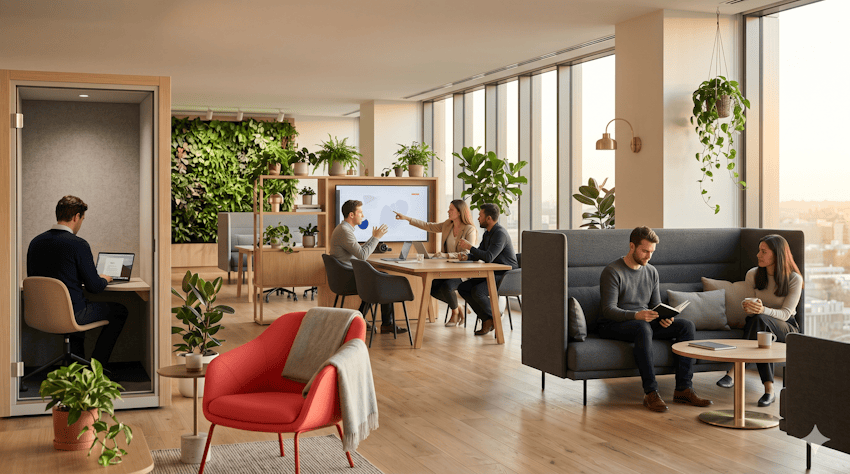
The office is no longer just a place where people sit at assigned desks. In a hybrid environment, it is a system of settings that supports focus, collaboration, calls, recovery, and social connection, while giving employees a reason to travel in.
Activity-based working, or ABW, is a workplace design approach that provides a range of settings so people can choose the right space for the task at hand. Hybrid work is the operating model that splits work between office and remote locations; the two are related, but they are not the same.
What the modern workplace is
A modern workplace is not defined by aesthetics alone. It is defined by whether the space supports the work patterns of the people using it, and whether the organization can manage that space over time.
The strongest workplace strategies usually combine three things: a varied physical environment, enabling technology, and workplace norms that make the system easy to use. ABW works best when these elements are aligned, not when the office merely adds a few booths and plants.
The five design principles
Modern workplaces are usually built around five design principles: non-assigned seating, biophilic design, workspace diversity, health-resilient design, and smart workplace systems.
1. Non-assigned seating
Non-assigned seating increases flexibility, but it is only effective when people have enough storage, enough space variety, and clear expectations about how the workplace is used. In practice, shared desks should be treated as a planning strategy, not a universal rule.
Desk-sharing ratios are best used as benchmarks rather than hard standards. The right ratio depends on attendance patterns, job type, peak-day occupancy, and whether the team is mostly office-based or field-based.
2. Biophilic design
Biophilic design brings natural elements into the workplace through daylight, planting, ventilation, natural textures, and views of nature. Research suggests that biophilic environments can support wellbeing, creativity, and productivity, although the strength of the effect varies by setting and design quality.
A useful way to think about biophilic design is that it should support performance, not just decoration. Simple moves such as improving access to daylight, adding planting, and using natural materials can help, but they should be balanced with acoustics, maintenance, and glare control.
3. Workspace diversity
A single workspace type cannot support the full range of knowledge work. People need places for deep focus, short calls, small-group collaboration, informal interaction, and scheduled meetings.
A practical floor plate should therefore mix focus areas, collaboration settings, private conversation spaces, scheduled meeting rooms, and social or support zones. This is more defensible than counting every chair as a work-point, because some spaces are meant for temporary use rather than all-day occupancy.
4. Health-resilient design
Health-resilient design focuses on indoor environmental quality, not just infection control. Evidence from office-building research shows that air quality, temperature, acoustics, and occupant perception all affect how well a workplace performs.
Good practice includes strong ventilation, cleanable finishes, reduced touch points where useful, and layouts that avoid unnecessary crowding. These features are part of baseline workplace quality, not luxury add-ons.
5. Smart workplace systems
Smart workplace systems help organizations understand how space is actually used. Booking tools, occupancy sensors, and utilisation reporting can be valuable, but only if the data leads to decisions.
The key is governance. Someone needs to own booking policy, occupancy review, move management, and the rules for changing space types over time. Without that, smart tools become dashboards without operational value.
How to plan the space
A complete workplace should be planned as a mix of setting types rather than a single open-plan field. The most useful structure is to divide space into five categories:
| Category | Purpose | Typical examples | Counted as work-points? |
| Focus work | Sustained individual work | Shared desks, solo desks, focus booths, work bars | Yes |
| Collaboration | Planned or spontaneous group work | Collaboration tables, stand-up tables, soft seating clusters | Yes, if used for extended work |
| Private conversation | Short confidential or low-distraction use | Solo pods, duo pods, call booths | Usually no |
| Scheduled meeting | Bookable group sessions | Huddle rooms, meeting rooms, project rooms | No |
| Social and support | Recharge, storage, and services | Pantries, lockers, wellness rooms, multi-faith rooms | No |
This distinction matters because not every seat should be counted as a base work-point. Pods and meeting rooms are useful, but they are usually support settings rather than places where someone spends most of the day.
Ratios and benchmarks
Ratios are useful planning guides, but they should not be treated as universal law. The right mix depends on attendance, role mix, collaboration habits, and whether the organization is in transition or fully embedded in a hybrid model.
A practical approach is:
-
- Cover normal peak attendance with core work-points.
-
- Add a temporary buffer for vendors, contractors, and visiting staff where needed.
-
- Size meeting rooms from actual meeting demand, not just headcount.
-
- Adjust desk-sharing ratios by role and attendance profile.
The same logic applies to utilization thresholds. If a meeting room is underused, the answer is not always to remove it; it may need a different room type, booking policy, or location. Utilization should trigger review, not automatic redesign.
Standards and accessibility
Compliance language should always be jurisdiction-specific. In Singapore, accessibility and universal design are grounded in the Code on Accessibility in the Built Environment, which sets baseline expectations for barrier-free access in new developments and major alterations.
The broader principle is simple: a modern workplace should be usable by people of different ages and abilities. That means clear circulation, accessible toilets, inclusive wayfinding, and design choices that support dignity and ease of use.
It is also best to separate mandatory requirements from design preferences. Ergonomic targets, lighting quality, acoustic comfort, and sustainability measures are all important, but they should be labelled correctly so the reader can tell what is required, what is recommended, and what is being proposed as a best-practice benchmark.
Measuring success
A workplace should be judged by outcomes, not only by ratios. Post-occupancy evaluation research shows that there is no single dominant evaluation method for office buildings, but occupant questionnaires are used consistently to assess indoor environmental quality and perceived performance.
Useful measures include:
-
- Occupant satisfaction with comfort, choice, and usability.
-
- Utilization patterns across zones and days.
-
- Indoor environmental quality, including air, temperature, and noise.
-
- Ease of collaboration across teams.
-
- The ability to adapt the workplace over time.
This is where many workplace strategies become incomplete. They launch a layout, but they do not define how feedback will be collected, reviewed, and acted on. A modern workplace needs an operating model, not just a floor plan.
Governance and review
The best workplace systems are actively managed. Someone should own policy for booking, storage, occupancy assumptions, move requests, and periodic review of space performance.
A simple governance rhythm works well:
-
- Monthly review of utilization and problem areas.
-
- Quarterly review with stakeholders from workplace, HR, and operations.
-
- Post-occupancy surveys after major changes.
-
- Annual recalibration of ratios, room types, and support spaces.
This keeps the workplace from drifting into informal territorial behavior or underused space. It also makes the design adaptable, which is essential in a hybrid environment.
Bottom line
The modern workplace is not a style. It is a managed system of space variety, environmental quality, technology, and governance that supports how work actually happens. The best offices are not the most decorative ones; they are the ones that stay useful, inclusive, and measurable over time.