
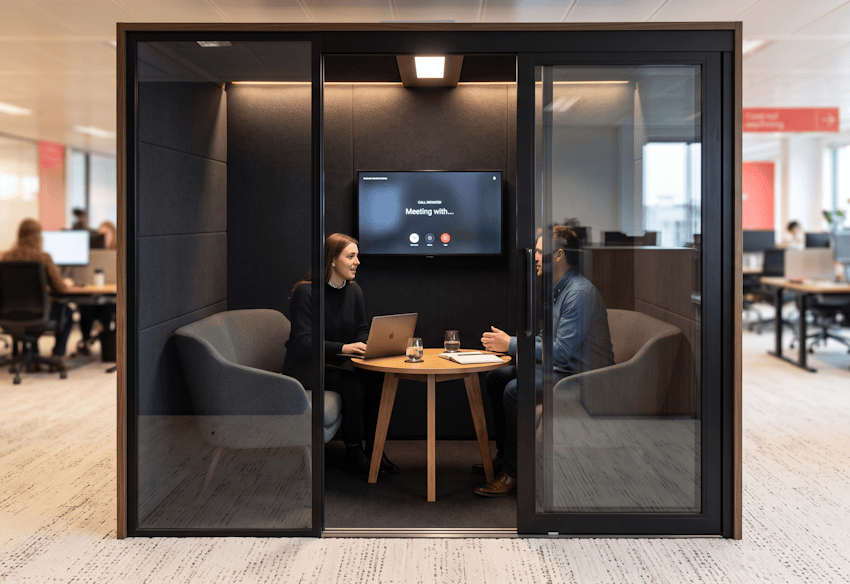
Sometimes two or three people just need to talk without booking a room or hunting for a free corner. That is the gap duo pods fill. A duo pod is a semi private space for two to four people to have a quick, confidential chat or a short work session. It is bigger and more comfortable than a solo phone booth but smaller than a meeting room, and it asks nothing of you. No booking, no formal setup. Like solo pods, duo pods run first come first served with a loose two hour cap, and people use them for quick huddles, client briefings, or small team coordination. Most organisations provision them at roughly a tenth of their workpoints, alongside solo pods and formal rooms. Below, we discuss how to size duo pods, avoid the common mistakes, and manage them in ecobook.
When and Why Organisations Use Duo Pods
Duo pods answer a specific need: privacy on demand for a small group. How many you need and where you put them depends a lot on how your teams work. A firm built on pair work and client calls burns through them. A heads down engineering team may barely touch them. So match provision to real usage, which is where ecobook’s occupancy data earns its keep.
Duo Pods Specifications
| Specification | Guidance |
| Floor area | Room for a small group to sit without feeling boxed in. |
| Capacity | Comfortable for a few people seated, with room for a couple to stand. |
| Configuration | Booth seating, a table, or modular furniture, whatever suits the spot. |
| Enclosure | Privacy film or partial walls with a door that lets air move. |
| Acoustic performance | Enough isolation for a private chat, with soft finishes to cut echo. |
| Power and data | A few outlets and an optional screen for sharing. |
| Usage limit | A loose cap per group, first come first served, no booking needed. |
| Workpoint value | A small share of total workpoints, alongside solo pods and rooms. |
Design Considerations
Three things decide whether a duo pod gets used: sound, comfort, and location. If people can be overheard, the privacy is fake and they will avoid it. If the seating is cramped, they will pick somewhere else. And if the pod is hard to find, even a good one sits empty. Soft finishes to cut echo, seating that fits four without a squeeze, and a spot near where people work will get you most of the way. The rest is lighting and how well it blends with the space around it.
Common Mistakes to Avoid
A few mistakes come up again and again:
1. Guessing at demand. Start conservative and add pods once the usage data shows you need them.
2. Weak sound isolation. Poor acoustics defeat the whole point of a private space.
3. Cramped or cheap furniture. An uncomfortable pod gets skipped.
4. Bad placement. A well built pod hidden away still sits empty.
5. No read on usage. Without occupancy data you cannot tell a popular pod from a forgotten one.
How Duo Pods Are Managed in ecobook
You can run duo pods two ways, and both have a downside. First come first served is the default. It keeps things simple and matches how people actually use pods, but there is no guarantee one is free when you need it, and a group can overstay the two hour cap. Making them bookable fixes the certainty problem, but it adds friction to what should be a walk up space and pods can end up reserved and empty.
ecobook supports either, and lets you switch. Duo pods can be considered meeting rooms and use the meeting room booking module. The booking system can enforce time limits and flag over use if you go bookable. Digital signage mounted outside the pods can allow for availability checks as well as a quick reservation of the pod for a short meeting. Occupancy sensors show how long people actually stay and how often pods fill up, whether or not you book them. So you can start open, watch the data, and only add booking if demand really calls for it.
Frequently Asked Questions
How much of this space type do we need?
Start with the recommended share and watch what happens. If pods are always full, add more. If they sit empty, check the location or whether people even know they are there before you pull them out.
Should this space be bookable or first-come-first-served?
It depends a lot on your use case. Steady, scheduled use suits booking. Sporadic, walk up use suits first come first served. Track the pattern in ecobook and set the policy to match.
How do we ensure equitable access to private spaces?
Clear rules, time limits, and a bit of monitoring. ecobook can enforce the limits and flag anyone sitting on a pod too long. Telling people what the pods are for and when they are free does the rest.
Wrapping Up
For example, a consulting firm of around 250 people scatters duo pods along its client facing floor. Consultants duck into one for a quick call, then step out again, no booking, no fuss. The pods stay busy and the meeting rooms stay free for real meetings. Plan your pods around where quick conversations actually happen, connect them to ecobook, and let the occupancy data tell you when to add more. Start with ecobook today.