
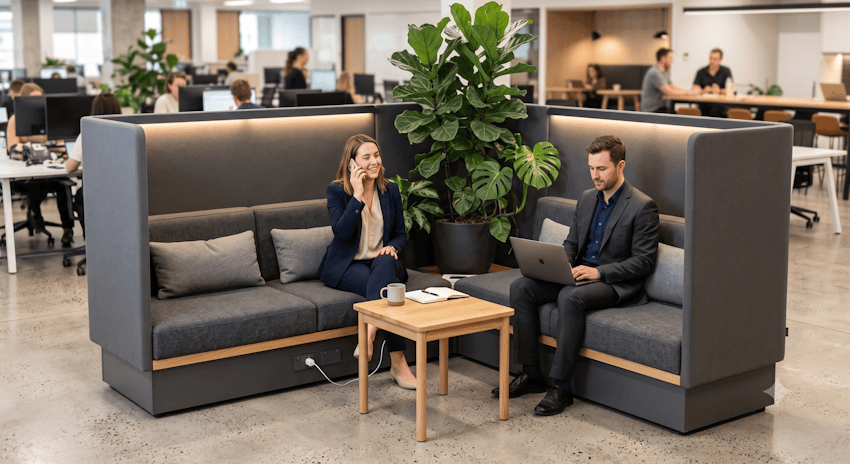
High back sofas and semi enclosed booths sit between fully open collaboration and a fully closed room. They give you soft seating for three or four people, in an L shape or a booth, with high upholstered panels and acoustic dividers. You get some visual and acoustic cover without shutting yourself in the way a solo booth does. They suit informal team talks, client chats, and small brainstorms where you want a bit of privacy but a closed room would feel like overkill. Most offices land on a small share of workpoints as high back sofas, with a few more as semi enclosed booths, for a balanced mix. Below, we discuss how to design these spaces, where to place them, and how to run them in ecobook.
When and Why Organisations Use High-Back Sofas and Semi-Enclosed Booths
These spaces solve the acoustic middle ground. Open collaboration tables are exposed and noisy. Solo booths are shut and can feel claustrophobic. High back sofas and semi booths sit in between. You get most of the privacy of a booth while the space stays open and easier to walk up to. They come in handy in a few situations:
1. Offices with heavy client traffic, where informal client meetings need some confidentiality but not a formal room.
2. Distributed teams where some discussions need focus, but a closed booth would feel isolating.
3. Places where staff say booths feel claustrophobic and a sofa feels more welcoming.
4. Biophilic layouts, where a sofa with plants and natural materials feels less institutional.
5. Team based work where three or four people huddle often but do not need a bookable meeting room.
It depends a lot on how you work. A client facing professional services firm leans on high back sofas for quick client briefings. A tech company that runs on written, asynchronous communication may hardly use them.
High-Back Sofa and Semi-Enclosed Booth Specifications
| Specification | Guidance |
| High-back sofa floor area | Enough footprint for L shaped seating for three or four people plus a small table. |
| Semi-enclosed booth floor area | Room for a few bench style seats with partition walls and no door. |
| Seating capacity | Comfortable, ergonomic upholstered seating for a small group. |
| Back panel height | High enough for visual privacy while you can still see over the panels. |
| Acoustic performance | Fabric wrapped acoustic panels on the back and sides that absorb speech noise. |
| Small table provision | One or two small work tables built into the sofa footprint. |
| Power and data | A couple of outlets in the frame or a nearby wall, with USB charging. |
| Lighting | Ambient office lighting plus an optional warm task light to ease eye strain. |
| Workpoint value | A modest share of total workpoints, split between sofas and booths. |
Design Considerations That Drive Adoption
Two things drive whether people use these spaces: the panels and the seat. Cheap fabric wrapped panels look institutional and absorb little. Good acoustic textiles in neutral greys, warm timber tones, or muted earth colours feel warm, do the acoustic job, and fit the ecobook palette. Without real acoustic treatment a sofa gives you visual cover but not much quiet.
Comfort matters as much. A workstation is built for a full day, but a sofa gets used for shorter sessions, so invest in upholstery with decent lumbar support. People avoid an uncomfortable sofa no matter how good the acoustics are. Location and setting finish the job. A sofa near collaboration zones and busy routes gets used. One buried in a quiet corner sits empty. Add plants, warm wood, and good lighting so it reads as an inviting spot, not a grey box.
Common Mistakes to Avoid
A few mistakes come up again and again:
1. Specifying a sofa with no acoustic treatment. You get visual privacy but not quiet.
2. Cheap upholstery. Shared seating takes heavy wear, and low grade fabric pills and fades within months.
3. Placing sofas inside quiet focus zones. They pull in conversation and disrupt nearby focus work, so keep them with the collaboration areas.
4. Too little power. People bring laptops and phones, and too few outlets kills the space fast.
5. Hiding them away. A sofa in a dead corner gets ignored, so put it where teams already gather.
How High-Back Sofas Are Managed in ecobook
High back sofas and semi enclosed booths usually run first come first served, with no booking. The advantage is that they stay casual and there is no admin. The downside is that a team can hover waiting for a popular spot, and you have no record of demand. The other option is to make the busier booths bookable as an “open” meeting room through ecobook. The advantage is guaranteed access and a clear usage trail. The downside is that booking adds friction to what should be a grab a seat space. Whichever you pick, ecobook’s occupancy sensors show which zones get used most, so you can justify adding sofas or moving the ones nobody touches.
Frequently Asked Questions
Do high-back sofas really provide meaningful acoustic privacy?
Partly. A high back sofa cuts speech noise enough to take the edge off, but it is not the isolation of a closed booth. For truly confidential talks, use a solo booth or a meeting room. For informal huddles and client briefings where you just want a bit of cover, a high back sofa does the job.
Should sofas be in open areas or more secluded?
Open, busy areas. Sofas tucked away get little use. Put them near pantries, lift lobbies, or main routes where teams gather anyway.
Can we use high-back sofas instead of meeting rooms?
For small, informal huddles, yes. For scheduled meetings with presentations, or external clients who expect a proper room, use a meeting room. The two serve different jobs.
Wrapping Up
For example, a design agency of around 120 people kept complaining that its solo booths felt like cupboards and stayed empty. They swapped two of them for high back sofas near the pantry, added plants and a warm task light, and the sofas filled up for client catch ups within a week. Plan these refuges around where people already gather, connect them to ecobook, and let the sensor data tell you which spots to grow and which to move. See what your quiet corners are really doing in ecobook today.